

How to Sell Online Courses in Kenya
Fast Onboarding System Adoption Workforce Skills Growth
The Real Operational Playbook Kenyan Trainers, Coaches, and Experts Are Using to Build Scalable Online Learning Businesses
- Built for African organisations
- Fast onboarding
- Customisable & fully supported
- For teams of all sizes

Explore & learn
The Real Challenge Starts After People Pay
Most people think selling online courses is mainly about:
- recording videos,
- building a website,
- or posting on social media.
That is only a small part of the problem.
The real challenge starts after people begin paying.
That is where most Kenyan trainers struggle.
Not because they lack expertise.
But because the operational side becomes messy very quickly.
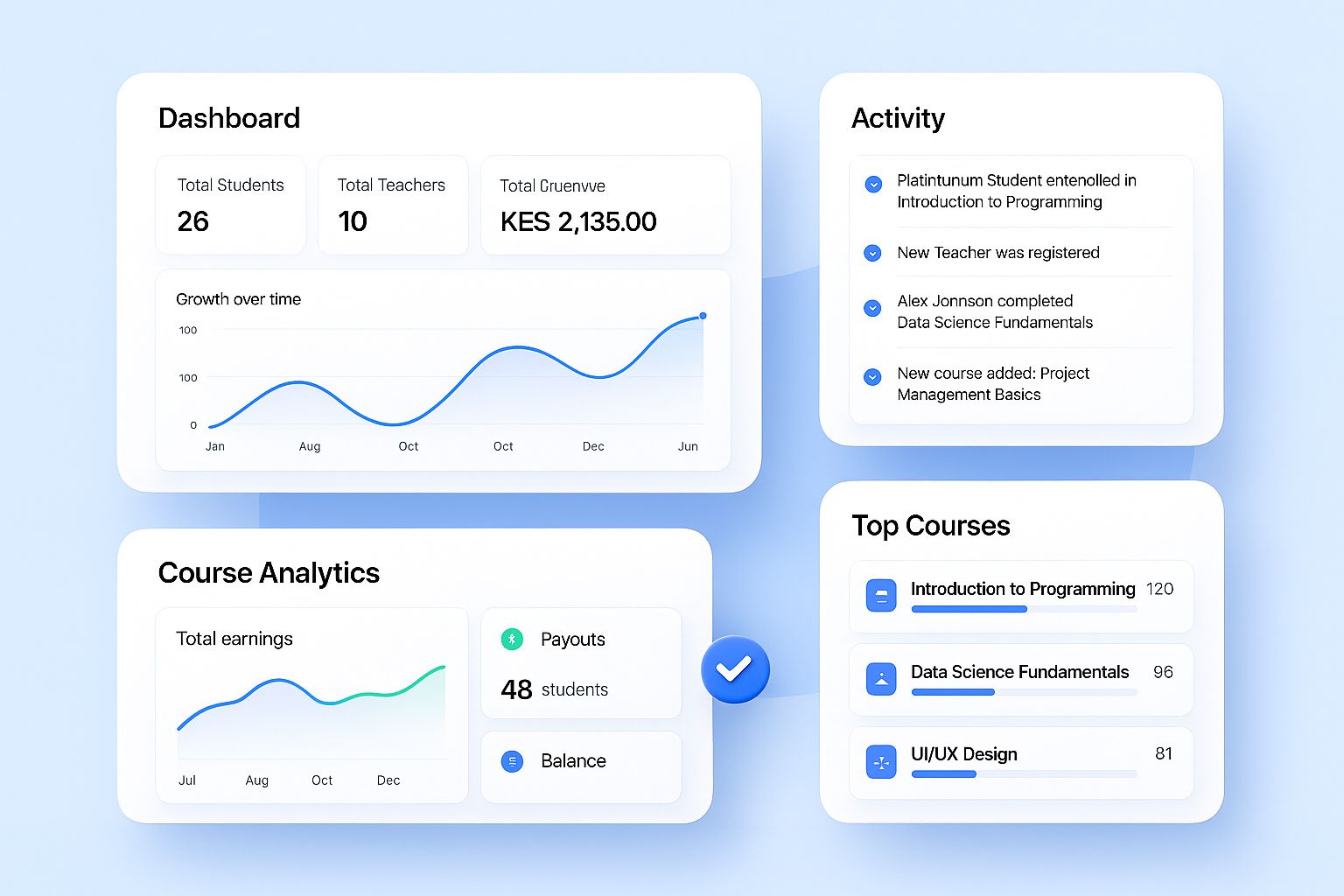
Many trainers still manage:
-
enrollments through WhatsApp,
-
M-Pesa confirmations manually,
-
Zoom links in group chats,
-
assignments through email,
-
certificates using Canva,
-
learner tracking through spreadsheets.
Perfect For;
That workflow eventually breaks.
Especially once:
-
learner numbers grow,
-
cohorts become larger,
-
support requests increase,
-
and learners expect professional experiences.
Selling online courses in Kenya today is no longer just a content problem.
It is:
- an infrastructure problem,
- an automation problem,
- a learner engagement problem,
- and increasingly an AI adaptation problem.
The trainers growing fastest in 2026 are not necessarily the best teachers.
They are the ones building systems around their expertise.
Problem Solved
Why Online Courses Are Growing Rapidly in Kenya
Several shifts are happening simultaneously across Kenya and Africa.
Perfect For;
The Biggest Mistake Trainers Make
Most trainers focus heavily on:
- course creation,
- branding,
- logos,
- websites.
But ignore:
- learner onboarding,
- payment systems,
- follow-up automation,
- learner engagement,
- completion rates,
- operational systems.
That is why many online courses fail after launch.
1. Knowledge Has Become a Business Model
Experts are increasingly monetizing:
- coaching,
- consulting,
- workshops,
- mentorship,
- certifications,
- and professional training.
People are packaging expertise into scalable digital products.
2.AI Is Increasing Demand for Reskilling
Businesses and professionals are trying to learn:
- AI workflows,
- automation,
- digital marketing,
- remote work systems,
- analytics,
- cybersecurity,
- productivity tools,
- leadership,
- sales.
This is creating massive demand for practical education.
3. Mobile Learning Is Becoming Dominant
Many learners in Kenya primarily access courses through:
- Android devices,
- mobile data,
- WhatsApp communities,
- and flexible schedules.
Desktop-first learning assumptions often fail in African markets.
4. Traditional Training Models Are Expensive
Venue costs,
transport,
printing,
scheduling,
and physical attendance limitations make traditional workshops difficult to scale.
Online learning reduces:
- operational costs,
- geographic limitations,
- and scheduling constraints.
Why Ujuziplus Wins
What Selling Online Courses Actually Looks Like in Kenya
Why Ujuziplus Wins
Example of a Typical Kenyan Training Workflow
A trainer launches:
“Digital Marketing Masterclass.”
Then:
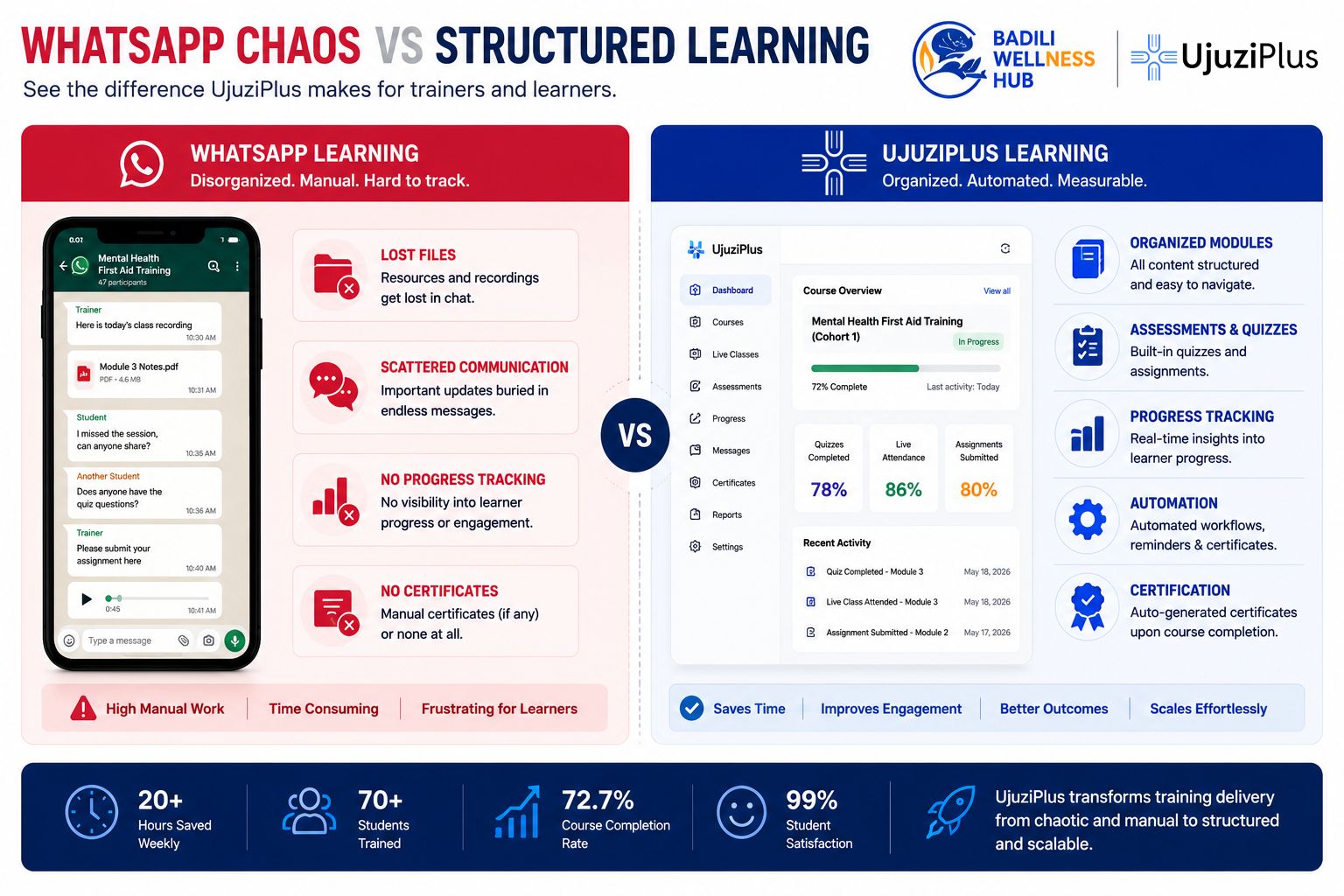
- Learners send M-Pesa screenshots manually
- Trainer confirms payments individually
- Zoom links are shared through WhatsApp
- Attendance tracking becomes inconsistent
- Assignments are scattered
- Follow-ups become manual
- Completion rates drop after week two
This creates:
- operational fatigue,
- poor learner experience,
- inconsistent engagement,
- slower business growth.
The issue is usually not teaching quality.
It is infrastructure quality
What Successful Trainers Are Doing Differently in 2026
The fastest-growing training businesses in Kenya are increasingly using:
-
cohort-based learning,
-
AI-assisted operations,
-
automated onboarding,
-
M-Pesa-integrated LMS systems,
-
WhatsApp engagement workflows,
-
community-driven learning,
-
certification systems,
-
mobile-first course delivery.
The shift happening now is:
training businesses are becoming operational systems, not just workshops.

Step-by-Step: How to Sell Online Courses in Kenya
Step 1: Choose a High-Demand Skill
Most successful online courses solve:
- career problems,
- income problems,
- business problems,
- compliance problems,
- productivity problems.
High-performing course categories currently include:
Category | Why Demand is Growing |
AI Skills | Businesses adapting to AI |
Digital Marketing | SME growth |
Leadership | Corporate reskilling |
Data Analysis | Hiring demand |
Sales Training | Revenue pressure |
Cybersecurity | Digital risk awareness |
HR Training | Compliance + onboarding |
Soft Skills | Remote work environments |
Step 2: Validate Demand Before Building
Many trainers waste months creating courses nobody buys.
Before building:
- test interest,
- run webinars,
- host workshops,
- create waitlists,
- ask your audience directly,
- post educational content.
A strong signal:
people repeatedly ask you for help on the same topic

Step 3: Structure the Learning Experience Properly
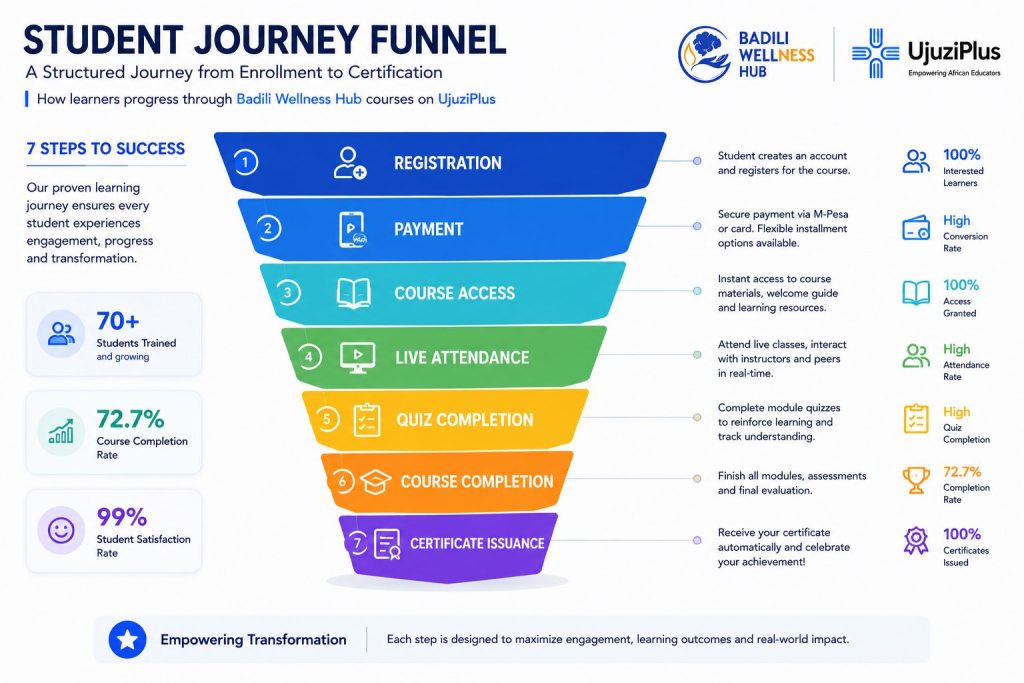
Most course creators underestimate structure.
Good learning experiences include:
- milestones,
- accountability,
- assignments,
- interaction,
- reminders,
- community engagement.
This is why cohort-based learning is growing rapidly.
Learners complete courses more consistently when:
- they feel observed,
- supported,
- accountable.
What is Cohort-BasedLearning?
Cohort-based learning means learners move through a course together within structured timelines.
Instead of:
“watch videos anytime,”
learners experience:
- deadlines,
- live sessions,
- community interaction,
- accountability systems.
Completion rates are usually much higher.
.
Perfect For;
Why M-Pesa Integration Matters So Much
Most Kenyan learners already trust:
M-Pesa.
Forcing:
- cards,
- PayPal,
- foreign checkout flows
creates unnecessary friction.
Trainers using localized payments often:
- close enrollments faster,
- improve trust,
- reduce abandoned checkouts.
Step 4: Use M-Pesa-Friendly Payment Systems
This is one of the most overlooked issues.
Many international platforms assume:
- card payments,
- PayPal,
- Stripe,
- global banking access.
But many Kenyan learners prefer:
- M-Pesa,
- mobile money,
- local payment workflows.
Payment friction kills conversions.
The easier it is for someone to pay,
the more likely they are to enroll.
Step 5: Stop Running Courses Through WhatsApp Alone
This is one of the biggest operational traps.
WhatsApp works well for:
- communication,
- reminders,
- engagement,
- community.
But it struggles with:
- structured learning,
- progress tracking,
- certifications,
- assignments,
- analytics,
- content organization.
The best approach is usually:
WhatsApp + LMS together.
What is the Best LMS for Selling Online Courses in Kenya?
The best LMS in Kenya should support:
- M-Pesa payments
- mobile-first learning
- low-bandwidth environments
- automation
- cohort learning
- WhatsApp integration
- learner analytics
- certificates
- scalability
Most global LMS platforms were not designed around African operational realities.
UjuziPlus vs Global LMS Platforms
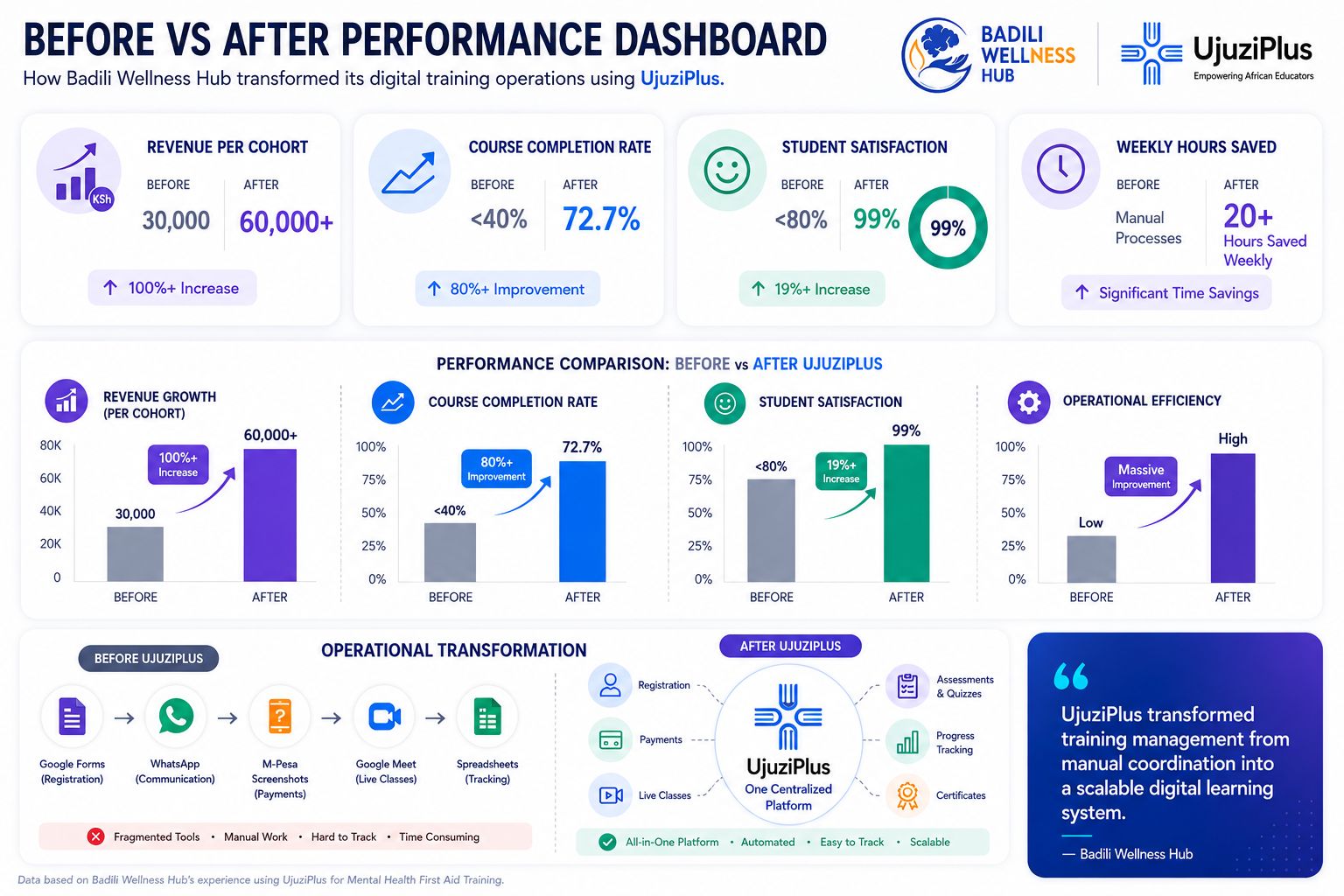
Most global LMS platforms were built for Western payment systems and desktop-first learning. UjuziPlus is designed around African training operations, M-Pesa workflows, and mobile-first learning.
| Platform | Biggest Advantage | Biggest Operational Challenge in Kenya |
|---|---|---|
| Moodle | Powerful customization | Technical setup complexity |
| Kajabi | Strong marketing tools | Limited localization for M-Pesa workflows |
| Teachable | Easy setup | Payment friction for African learners |
| Thinkific | Modern UI | Weak localization for African training operations |
| UjuziPlus Best for Africa | Built around African learning infrastructure | Focused specifically on local operational realities |
Step 6: Automate Enrollment & Onboarding
One of the biggest operational upgrades trainers can make is:
removing manual admin work.
Modern LMS systems help automate:
- payment confirmations,
- onboarding,
- learner access,
- reminders,
- certificates,
- progress tracking.
Automation matters because training businesses become difficult to scale manually.
Our advantage
How AI Is Changing Online Course Businesses
AI is not replacing trainers.
It is reducing operational friction.

The Hidden Problem Most Trainers Ignore
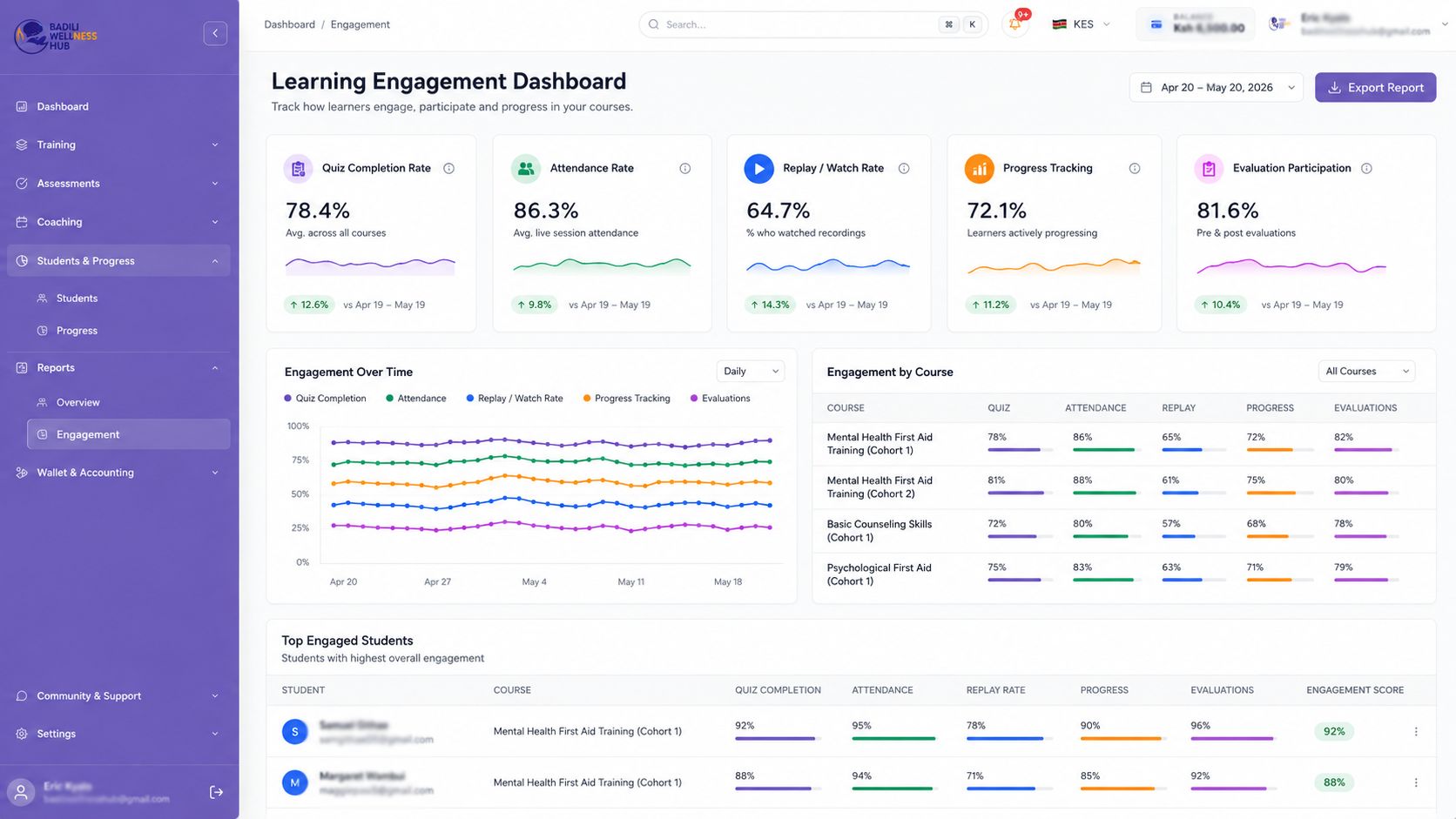
Most online courses fail because learners disengage.
Not because the information is bad.
But because:
- learners feel isolated,
- follow-up is weak,
- accountability disappears,
- onboarding is confusing.
This is why:
- cohort systems,
- reminders,
- community learning,
- progress tracking,
- WhatsApp engagement
matter so much.
Why Mobile Learning Matters in Africa
Many African learners:
- do not primarily use laptops,
- rely on smartphones,
- consume content during work breaks,
- use mobile data carefully.
Platforms designed mainly for desktop learning often perform poorly.
The future of African online learning is likely to remain:
- mobile-first,
- lightweight,
- flexible,
- community-driven.
What Successful Kenyan Coaches Are Doing
Many successful coaches are now:
- packaging frameworks into courses,
- building recurring cohorts,
- creating certification systems,
- combining live + recorded learning,
- using communities to improve retention.
The shift is:
coaches are becoming media + education businesses.
Our advantage
Common Mistakes Trainers Make
Frequently Asked Questions
Most trainers combine:
- LMS platforms,
- M-Pesa payments,
- WhatsApp communities,
- Zoom sessions,
- cohort learning,
- and educational content marketing.
The best LMS for Kenya should support:
- M-Pesa,
- mobile learning,
- automation,
- WhatsApp communication,
- learner analytics,
- cohort systems.
You can start there.
But scaling becomes difficult without:
- structured learning systems,
- automation,
- progress tracking,
- certificates.
Moodle is powerful but often requires technical setup and maintenance.
Many trainers prefer simpler operational workflows.
High-demand categories include:
- AI,
- digital marketing,
- leadership,
- sales,
- productivity,
- data analysis,
- compliance,
- remote work skills.
Yes.
Especially when optimized for:
- mobile learners,
- local payment systems,
- community engagement,
- low-bandwidth access.
Income varies based on:
- audience size,
- positioning,
- pricing,
- completion rates,
- marketing systems,
- operational efficiency.

The Future of African Education Will Be Built by Trainers Who Understand Systems, Not Just Content
The biggest shift happening right now is:
knowledge businesses are becoming infrastructure businesses.
The trainers winning in 2026 are:
- automating operations,
- improving learner engagement,
- building communities,
- integrating AI,
- and reducing friction across the learner journey.
UjuziPlus helps trainers:
- manage learning professionally,
- automate enrollments,
- integrate M-Pesa,
- centralize learner experiences,
- and scale online education businesses built for African realities.