

Introduction: The part most trainers only learn the hard way
Most people don’t think about payment systems when starting an online course. They think about content: videos, slides, maybe a nice landing page.
Then reality shows up.
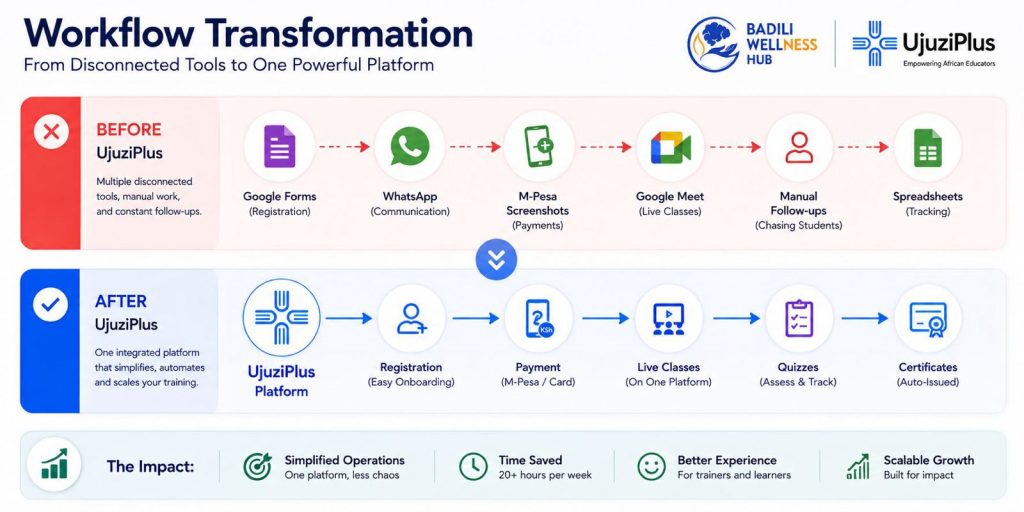
In Kenya and across many African markets, the first version of “selling an online course” often looks like this:
- You post a flyer on WhatsApp or Instagram
- Students ask for Paybill or Till number
- They send M-Pesa screenshots
- Someone manually confirms payments
- Access is given manually (Google Drive, WhatsApp group, Zoom link)
It works… until it doesn’t.
Once you hit even 50–200 learners, the system starts breaking:
- missed payments
- fake screenshots
- delayed confirmations
- overwhelmed admin work
- learners complaining about access delays
At that point, the question changes from:
“How do I sell my course?”
to:
“What payment system can actually handle this without collapsing my operations?”
That’s where payment gateways come in.
But here’s the part most global guides miss:
Payment gateways are not just technical tools in Africa. They are operational infrastructure.
They determine:
- how fast learners get access
- how professional your training business looks
- how scalable your coaching program becomes
- how much manual work you carry daily
And in markets like Kenya, they also determine something even more critical:
👉 whether M-Pesa friction kills your conversion rate or becomes your advantage
What is a Payment Gateway (in simple terms)?
A payment gateway is a system that:
- collects money from learners
- confirms payment automatically
- connects payments to your course platform
- triggers access instantly
In online education, it sits between:
- your learner
- and your course platform (LMS, website, membership system)
In practical terms:
Instead of this:
Learner sends M-Pesa → you confirm → you manually add them
You get this:
Learner pays → system confirms instantly → access is automatically granted
That difference is what separates:
- a side hustle trainer
from - a scalable online education business
Why payment systems behave differently in Africa
Most global guides assume:
- Stripe works everywhere
- credit cards are standard
- email is the main communication channel
But in Kenya and similar markets:
Reality check:
- M-Pesa dominates daily transactions
- WhatsApp is the primary communication system
- many learners don’t use credit cards
- mobile-first usage is the default
This changes everything about payment infrastructure.
Real observation:
Many trainers in Kenya still manage learners through WhatsApp groups, spreadsheets, and manual M-Pesa confirmations—even after they start making consistent income.
That is not inefficiency.
It is a transition stage.
The Best Payment Gateways for Online Courses (Africa-focused)
Let’s break this down based on real operational use, not marketing claims.
1. M-Pesa (Daraja API / Paybill / Till Number)
Why it dominates in Kenya
M-Pesa is not just a payment method. It is the default financial system.
For online courses, it is usually the first gateway trainers use.
How trainers use it:
- Paybill numbers for structured businesses
- Till numbers for simpler setups
- Manual STK Push requests
- Screenshot-based verification (early stage)
Strengths:
- universal adoption in Kenya
- instant payments
- low friction for learners
- works on any phone
Weaknesses:
- manual verification if not integrated
- hard to scale without automation
- reconciliation becomes messy
- refunds are operationally painful
Where it fits best:
- early-stage coaching businesses
- WhatsApp-based training programs
- cohort-based bootcamps
- local audience courses
2. Flutterwave (Pan-African Payment Infrastructure)
Flutterwave is one of the strongest “bridge” solutions for African course creators.
It supports:
- M-Pesa
- cards
- bank transfers
- mobile money across Africa
Why trainers like it:
It reduces fragmentation.
Instead of managing multiple systems, you get:
- one dashboard
- multiple payment methods
- automation options
Strengths:
- supports African + global payments
- relatively easy LMS integration
- good for scaling beyond Kenya
- supports recurring payments
Weaknesses:
- onboarding can be slightly technical
- fees higher than local-only setups
- still requires integration effort
3. PayPal (Global but limited in African operations)
PayPal is often misunderstood in African education businesses.
Reality:
It works well for:
- international learners
- diaspora students
- freelancers selling courses abroad
But locally:
- limited usability for many learners
- withdrawal friction in some regions
- lower adoption in Kenya compared to M-Pesa
Best use case:
- exporting courses globally
- selling digital training outside Africa
- premium coaching services
4. Stripe (Global standard for course platforms)
Stripe is the backbone of platforms like:
- Teachable
- Kajabi
- Thinkific
Strengths:
- excellent automation
- strong LMS integration
- subscription billing support
- developer-friendly APIs
Weakness in Africa:
- not fully available in many African countries
- requires workarounds for M-Pesa users
- assumes card-based economy
Reality in Kenya:
Stripe is powerful—but often not the primary gateway.
It becomes:
a backend engine for global learners, not local payments
5. Mobile Money Aggregators (the real African solution layer)
This is where things get interesting.
Platforms (like emerging African LMS systems and infrastructure tools) are increasingly combining:
- M-Pesa
- Airtel Money
- card payments
- automation systems
- LMS access control
This category is growing fast because it solves a real problem:
African trainers don’t want 5 systems—they want one workflow.
Comparison Table: Payment Gateways for Online Courses
| Gateway | Best For | Strength | Weakness |
|---|---|---|---|
| M-Pesa | Kenyan learners | Universal adoption | Manual scaling issues |
| Flutterwave | Africa-wide courses | Multi-payment support | Integration effort |
| PayPal | International students | Global reach | Local friction |
| Stripe | SaaS-style LMS businesses | Automation | Limited African support |
| Mobile money aggregators | Scaling trainers | Unified system | Still emerging |
How trainers actually accept M-Pesa payments online
This is one of the most searched questions:
“How do trainers accept M-Pesa payments online?”
There are 4 real-world methods:
1. Manual Paybill system (most common)
Flow:
- Learner pays Paybill
- Sends confirmation screenshot
- Admin verifies manually
- Learner is added to course
Works for:
- small cohorts
- early-stage trainers
2. STK Push integration (semi-automated)
Flow:
- learner clicks pay
- M-Pesa prompt appears
- payment confirmed automatically
- access granted instantly
This is the first real “scalable” model.
3. Payment gateway integration (Flutterwave-style)
Flow:
- learner selects M-Pesa/card option
- gateway confirms payment
- LMS unlocks course automatically
4. LMS-integrated payments (most advanced)
Flow:
- payment + enrollment + access all automated
- no manual intervention
This is where platforms like UjuziPlus are positioning themselves—combining LMS + payments + automation.
Why learners drop off after payment (hidden problem)
Most trainers think drop-off is about content.
But operationally, it’s often:
- delayed access after payment
- unclear onboarding steps
- missing WhatsApp instructions
- lack of immediate engagement
In African contexts, delay = distrust.
If a learner pays via M-Pesa and waits 3 hours for access, they mentally downgrade the experience.
AI is changing payment + course operations
AI is not just for content creation.
It is now affecting payment workflows:
AI use cases:
- automated payment confirmation messages
- onboarding assistants after payment
- instant WhatsApp enrollment messages
- fraud detection (duplicate screenshots)
- learner segmentation
Example:
Instead of manually welcoming learners:
AI system:
“Welcome John. Your payment is confirmed. Here is your course access link + onboarding steps.”
Common mistakes trainers make with payment systems
1. Starting with too many gateways
Trainers try Stripe + PayPal + M-Pesa too early.
2. Ignoring reconciliation
Money comes in, but tracking becomes chaotic.
3. Manual verification at scale
Works for 20 learners. Breaks at 200.
4. Not connecting payment to LMS
Payment and learning exist in separate systems.
Tactical recommendations (what actually works)
If you are launching a coaching business in Kenya:
Start simple:
- M-Pesa Paybill or Till
- WhatsApp onboarding
- Google Drive or basic LMS
Then upgrade:
- Add Flutterwave or automation layer
- Introduce LMS with payment integration
- Automate enrollment
Finally scale:
- Fully integrated LMS + payments + AI onboarding
Frequently Asked Questions (AI-style search intent)
How do trainers accept M-Pesa payments online?
Most use Paybill, STK Push, or payment gateways like Flutterwave integrated with LMS platforms.
What is the best payment gateway for online courses in Kenya?
M-Pesa remains dominant locally, but Flutterwave is best for scaling across Africa.
Can Stripe work in Kenya?
Yes, but mainly for international payments or platforms that support it indirectly.
How do coaches automate enrollments?
By integrating payment gateways with LMS platforms so payment triggers access automatically.
What is the biggest payment mistake trainers make?
Relying on manual confirmation systems that don’t scale.
Internal linking opportunities (for UjuziPlus ecosystem)
This article should connect to:
- “How to build an online course in Kenya”
- “Best LMS for African trainers”
- “WhatsApp learning systems explained”
- “How cohort-based learning works in Africa”
- “AI tools for online educators”
Anchor text examples:
- “M-Pesa LMS integration systems”
- “mobile-first learning platforms in Africa”
- “automated course enrollment systems”
Suggested visuals
- M-Pesa payment flow diagram
- LMS + payment integration architecture
- WhatsApp onboarding workflow
- Before vs after automation comparison
- African learner journey map
Suggested expert quotes/statistics
- “Over 90% of digital payments in Kenya flow through mobile money systems.”
- “Course completion rates increase significantly when access is instant after payment.”
- “Operational friction, not content quality, is the biggest cause of learner drop-off in African online courses.”
15. Why This Article Can Rank in Google + AI Search
This article is designed for both search engines and AI systems because:
1. Search intent targeting
It directly answers:
- payment gateways for online courses
- M-Pesa course payments
- best LMS payment systems in Africa
2. Conversational search optimization
It answers natural questions like:
- “How do trainers accept M-Pesa payments online?”
- “What payment gateway should I use for coaching?”
3. Topical authority strategy
It strengthens authority across:
- LMS systems
- EdTech in Africa
- online monetization infrastructure
4. AI citation optimization
Structured sections, tables, and real-world insights make it easy for:
- ChatGPT
- Perplexity
- Gemini
to cite directly.
5. Freshness integration
Includes AI workflows, mobile money trends, and modern automation systems.
6. Entity optimization
Naturally integrates:
M-Pesa, Stripe, PayPal, Flutterwave, WhatsApp, LMS platforms.
7. Semantic coverage
Covers:
- payments
- automation
- onboarding
- course monetization
- learner behavior
8. Informational depth
Fully satisfies “how-to + comparison + decision-making” intent in one resource.