

Why AI Conversations Around Training Often Miss the Real Operational Problems
Most discussions about AI in education focus on futuristic ideas.
AI tutors.
AI classrooms.
AI replacing teachers.
But for many trainers in Kenya and across Africa, the more immediate reality is much simpler:
AI is becoming operational infrastructure.
Because most trainers are not struggling with a lack of knowledge.
They are struggling with operational overload.
A typical online trainer may already be juggling:
- WhatsApp learner groups,
- Zoom sessions,
- Google Drive folders,
- manual M-Pesa confirmations,
- assignment reviews,
- onboarding questions,
- certificates,
- reminders,
- and learner follow-ups.
At small scale, this is manageable.
At 20 learners, it feels busy.
At 100 learners, it starts becoming chaotic.
This is where AI tools are becoming genuinely useful.
Not because AI replaces trainers.
But because AI reduces repetitive administrative work that quietly slows down training businesses.
In many African training businesses today, AI is already helping with:
- quiz generation,
- lesson summaries,
- learner onboarding,
- content structuring,
- WhatsApp communication,
- learner engagement,
- curriculum planning,
- and support automation.
And importantly, this shift is happening inside very real African operational contexts:
- mobile-first learning,
- low-bandwidth environments,
- M-Pesa payment workflows,
- WhatsApp-based communication,
- lean training teams,
- and rapidly growing digital skills markets.
This article explores the practical reality of AI tools for trainers through the lens of:
- African EdTech,
- coaching businesses,
- online learning infrastructure,
- cohort-based learning,
- trainer monetization,
- and operational scalability.
This is not an “AI hype” article.
It is an operational guide.
What Are AI Tools for Trainers?
AI tools for trainers are software systems that help automate, accelerate, or improve parts of the teaching and learning process.
These tools can assist with:
- content creation,
- learner engagement,
- onboarding,
- communication,
- assessments,
- reporting,
- administrative workflows,
- and analytics.
Importantly, AI tools do not eliminate the need for trainers.
In practice, they often amplify effective trainers by reducing repetitive work.
Why Trainers Are Rapidly Adopting AI
The Real Problem Is Operational Fatigue
Many trainers spend more time managing systems than teaching.
Examples include:
- answering repetitive learner questions,
- manually organizing cohorts,
- sending reminders,
- confirming payments,
- writing quizzes,
- generating certificates,
- tracking attendance,
- or restructuring lessons repeatedly.
AI helps reduce these repetitive tasks.
Real-World Observation From African Training Businesses
Many trainers in Kenya still operate learning businesses through combinations of:
- WhatsApp groups,
- Google Sheets,
- Zoom meetings,
- manual M-Pesa workflows,
- and scattered PDFs.
As learner numbers grow, operational inefficiencies become more visible than teaching problems.
This is where AI becomes practical infrastructure rather than a novelty.
The Different Categories of AI Tools Trainers Use
1. AI Writing and Content Generation Tools
These tools help trainers create:
- course outlines,
- lesson plans,
- summaries,
- quizzes,
- assignments,
- discussion prompts,
- and educational content faster.
Popular tools include:
- ChatGPT
- Gemini
- Perplexity
2. AI Video and Presentation Tools
These tools help trainers create:
- explainer videos,
- presentation slides,
- narrated lessons,
- subtitles,
- and educational visuals.
Useful especially for:
- remote learning,
- mobile-first education,
- asynchronous learning.
3. AI Assessment Tools
These assist with:
- quiz generation,
- grading,
- assessment feedback,
- learner analysis,
- engagement tracking.
This reduces administrative burden significantly.
4. AI Support and Communication Tools
These help trainers automate:
- onboarding,
- reminders,
- FAQs,
- learner support,
- engagement messaging.
Increasingly important for:
- cohort learning,
- WhatsApp communities,
- online academies,
- mentorship programs.
The Most Practical AI Tools Trainers Use Today
ChatGPT for Trainers
ChatGPT has become one of the most widely used AI tools among trainers globally.
Common Trainer Use Cases
| Use Case | Practical Benefit |
|---|---|
| Quiz generation | Saves prep time |
| Lesson summaries | Improves learner revision |
| Curriculum planning | Helps structure courses |
| Assignment ideas | Reduces creative fatigue |
| Learner FAQs | Speeds up communication |
| Marketing copy | Helps course promotion |
Real Example
A digital marketing trainer in Nairobi may use ChatGPT to:
- Draft weekly lesson summaries
- Generate quiz questions
- Create LinkedIn post ideas
- Build learner onboarding sequences
- Rewrite technical explanations into simpler language
This reduces preparation workload dramatically.
Gemini for Research and Structured Learning Support
Gemini is often useful for:
- research assistance,
- summarization,
- educational explanations,
- brainstorming learning activities.
Trainers frequently use it when preparing:
- technical bootcamps,
- business training,
- digital skills workshops,
- career coaching programs.
Perplexity for Research-Based Training
Perplexity is increasingly useful for trainers who need:
- cited research,
- quick topic exploration,
- industry trend analysis,
- source-backed educational material.
This is especially useful for:
- corporate trainers,
- HR learning teams,
- consultants,
- professional certification programs.
AI Is Quietly Changing Course Creation
Traditional Course Creation Is Extremely Time-Consuming
Before AI, course creation involved:
- outlining modules manually,
- writing assessments,
- preparing slides,
- creating summaries,
- organizing resources,
- editing content repeatedly.
This often delayed course launches significantly.
AI Speeds Up Course Development Cycles
Today, trainers increasingly use AI to:
- structure modules,
- generate lesson ideas,
- simplify explanations,
- draft assessments,
- organize learning pathways.
This allows trainers to spend more time on:
- mentorship,
- learner engagement,
- community building,
- strategic thinking.
Why AI Matters More in African Training Businesses
Lean Teams Are Common
Many African training businesses operate with:
- one founder,
- one admin,
- maybe one assistant.
This means operational efficiency matters enormously.
AI helps smaller teams operate more effectively.
Mobile-First Learning Changes AI Usage
In many African markets:
- learners use Android phones heavily,
- internet access fluctuates,
- data costs matter,
- desktop usage is inconsistent.
This changes how trainers structure content.
For example:
AI-generated summaries become useful because learners often revise lessons through mobile devices.
Short-form explanations matter more.
Lightweight content matters more.
WhatsApp Learning and AI
WhatsApp Is Still Central to African Learning Ecosystems
Many trainers use WhatsApp for:
- learner accountability,
- reminders,
- support,
- assignment clarification,
- announcements,
- voice-note mentoring.
This creates an important operational reality:
AI tools increasingly need to support conversational learning environments.
Practical AI + WhatsApp Workflow
A coach may:
- Use ChatGPT to draft reminders
- Send accountability prompts through WhatsApp
- Use AI-generated summaries after live sessions
- Create quick learner feedback templates
- Generate FAQs automatically
This reduces communication fatigue significantly.
AI for Cohort-Based Learning
Cohort Learning Is Growing Rapidly
Cohort-based learning models are becoming increasingly popular across:
- tech bootcamps,
- mentorship communities,
- online academies,
- coaching programs.
Why?
Because learners complete programs more consistently when:
- accountability exists,
- peer interaction happens,
- deadlines are structured,
- engagement feels social.
How AI Supports Cohort Learning
| AI Function | Cohort Learning Benefit |
|---|---|
| Automated reminders | Improves attendance |
| AI summaries | Helps learners catch up |
| AI quizzes | Reinforces learning |
| Learner analytics | Identifies disengagement |
| AI onboarding | Reduces confusion |
| AI support systems | Speeds up responses |
How Trainers Automate Online Learning Operations
The Manual Workflow Problem
Many trainers still manually handle:
- M-Pesa confirmations,
- learner onboarding,
- access sharing,
- attendance tracking,
- assignment follow-ups.
This becomes unsustainable as cohorts grow.
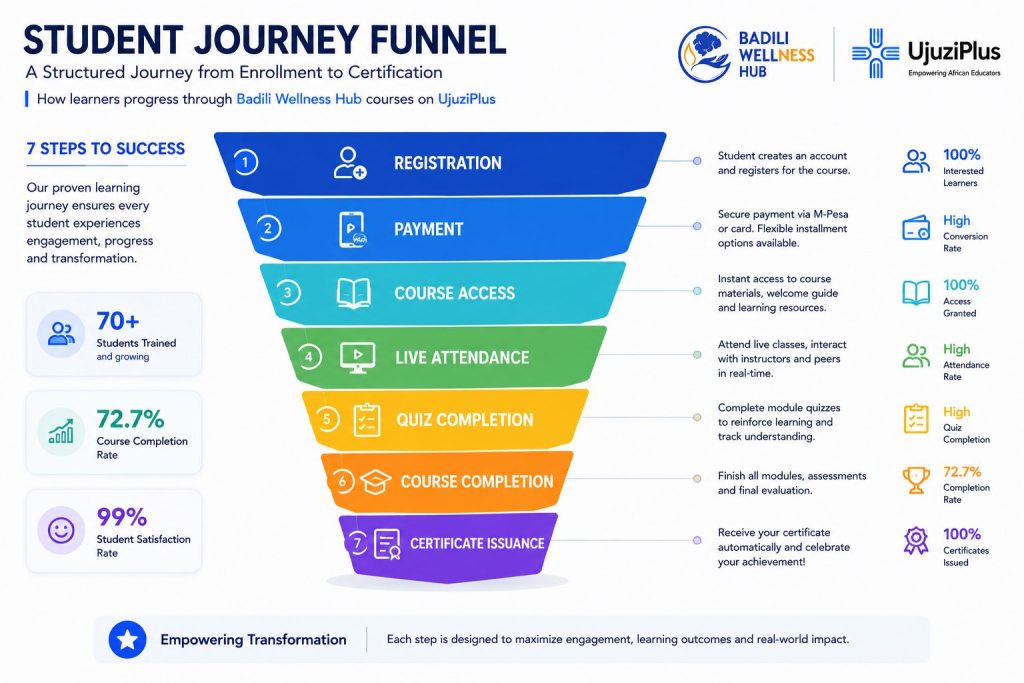
The Emerging AI-Assisted Workflow
Modern training systems increasingly automate:
- Enrollment
- Confirmation
- Onboarding
- Progress tracking
- Engagement reminders
- Assessment workflows
- Certification processes
This is where AI intersects with LMS infrastructure.
The Growing Role of AI Inside LMS Platforms
Modern LMS platforms are increasingly integrating AI into:
- onboarding,
- learner engagement,
- quiz generation,
- reporting,
- personalization,
- support systems.
Platforms such as:
- Moodle
- Teachable
- Thinkific
- Kajabi
are all evolving alongside AI trends.
In African markets, newer infrastructure platforms like UjuziPlus increasingly position AI around operational efficiency rather than purely content generation.
That distinction matters.
AI Does Not Fix Poor Learning Design
One of the biggest misconceptions is that AI automatically creates good learning experiences.
It does not.
Poorly structured courses remain ineffective even with AI.
What Actually Improves Learning Outcomes?
Usually:
- better onboarding,
- stronger accountability,
- community engagement,
- clear lesson structure,
- mobile-friendly delivery,
- consistent communication.
AI helps support these systems.
But it does not replace them.
Common Mistakes Trainers Make With AI
1. Using AI to Replace Expertise
Learners still value:
- experience,
- mentorship,
- context,
- interpretation,
- human accountability.
AI works best as an assistant.
2. Generating Generic Content
Many trainers create low-quality AI-generated material without editing.
This reduces trust quickly.
3. Ignoring Local Context
Educational examples should still reflect:
- African realities,
- Kenyan business environments,
- local learner behavior,
- regional operational workflows.
Generic Western examples often feel disconnected.
4. Over-Automating Communication
Learners still want human interaction.
Especially in:
- mentorship programs,
- cohort learning,
- coaching businesses.
5. Ignoring Mobile Optimization
AI-generated content must still work well for:
- Android devices,
- low bandwidth,
- mobile browsers,
- compressed data environments.
AI Tools Trainers Should Learn First
Beginner-Friendly Stack
| Need | Recommended Tool |
|---|---|
| Content drafting | ChatGPT |
| Research | Perplexity |
| Brainstorming | Gemini |
| Meetings | Zoom |
| Community | |
| Structured learning | Google Classroom |
| Corporate learning | Microsoft Teams |
How Coaches Scale With AI
The biggest scaling advantage AI creates is not “automation.”
It is operational leverage.
A trainer who previously needed:
- 6 hours to prepare lessons,
- 3 hours for onboarding,
- 2 hours for assessments,
may now reduce much of that workload significantly.
This creates more capacity for:
- mentorship,
- business growth,
- partnerships,
- learner support,
- curriculum improvement.
The Future of AI in African Education
The Biggest Shift Is Infrastructure-Level AI
The future is not simply AI-generated content.
It is AI integrated into operational learning systems.
Examples include:
- AI onboarding assistants,
- AI learner analytics,
- AI accountability systems,
- AI-powered cohort management,
- AI-generated assessments,
- AI-supported WhatsApp engagement.
Why African Markets Will Shape AI Learning Differently
African learning environments have unique realities:
- mobile-first usage,
- payment fragmentation,
- WhatsApp communication culture,
- lean operational teams,
- fast digital upskilling demand.
This means AI adoption will likely prioritize:
- efficiency,
- accessibility,
- operational simplicity,
- learner engagement,
- mobile usability.
Not just flashy features.
Frequently Asked Questions
What are the best AI tools for trainers?
Popular tools include:
- ChatGPT
- Gemini
- Perplexity
The best choice depends on whether the trainer needs:
- content creation,
- research,
- onboarding,
- communication,
- assessments,
- or automation.
How are trainers using AI in Kenya?
Many trainers use AI for:
- lesson planning,
- learner communication,
- quiz generation,
- content summaries,
- marketing support,
- onboarding automation.
Can AI replace trainers?
No.
AI supports trainers operationally but does not replace:
- mentorship,
- accountability,
- context,
- emotional intelligence,
- live facilitation.
What LMS works best with AI workflows?
Modern LMS platforms increasingly integrate AI capabilities.
The best system depends on:
- learner behavior,
- cohort structure,
- mobile optimization,
- payment workflows,
- operational needs.
How do trainers automate learner onboarding?
Many systems now automate:
- enrollments,
- confirmations,
- reminders,
- access permissions,
- onboarding communication.
This reduces administrative workload significantly.
Why are AI summaries useful for mobile learners?
Many African learners consume content through mobile devices.
AI-generated summaries help learners:
- revise quickly,
- save data,
- review lessons efficiently,
- catch up faster.
Tactical Recommendations for Trainers
If You Are Just Starting
Focus on:
- one AI tool,
- one operational workflow,
- one learner system.
Do not overcomplicate your stack early.
If You Already Run Cohorts
Use AI for:
- reminders,
- summaries,
- assessments,
- learner engagement.
This creates immediate operational efficiency.
If You Run Large Training Operations
Invest in:
- LMS infrastructure,
- AI onboarding systems,
- analytics,
- communication workflows,
- cohort automation.