

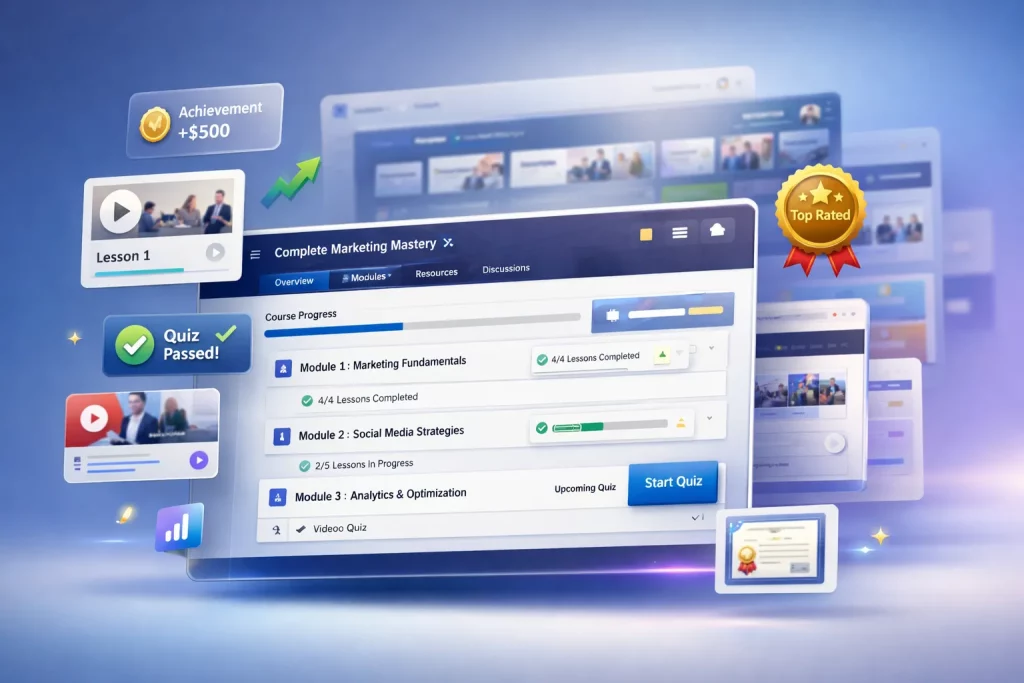
Most LMS platforms fail because you’re using them for the wrong job.
If you’re training clients, partners, or customers, you’re not doing internal L&D anymore. You’re running a training business and most LMS platforms were never designed for that.
This is where things start breaking.
The Real Problem: LMS Platforms Weren’t Built for External Training
Tools like SAP SuccessFactors and Workday were built for:
- employees
- internal compliance
- HR-controlled environments
They work perfectly… until you try to:
- sell training externally
- manage multiple client organizations
- issue certifications with renewals
- run blended programs (live + async)
At that point, you’re forcing the system to do something it wasn’t designed for.
What Actually Breaks (Real Scenarios)
1. Multi-Client Chaos (No True Multi-Tenant LMS)
You onboard 5 clients.
Then:
- Client A logs in and sees shared dashboards
- Reporting is mixed across organizations
- You’re manually filtering data for each client
Now you have a data separation problem and potentially a compliance risk.
2. Certification Tracking Becomes Manual Work
You promise:
- certifications
- expiry tracking
- renewals
Reality:
- no automated reminders
- no structured renewal workflows
- reports are hard to generate
So you end up:
- exporting data
- tracking expiry dates in spreadsheets
- chasing users manually
That’s not scalable.
3. Audit & Compliance Reporting Is a Headache
Before every audit:
- you scramble to export reports
- clean up data
- format it for regulators or clients
Instead of one-click compliance reporting, you’re doing manual work every time.
4. Blended Learning = Tool Spaghetti
Your setup looks like this:
- LMS → course content
- Zoom → live sessions
- Email → communication
- Sheets → tracking
Nothing talks to each other properly.
You’re not running a system. You’re patching tools together.
What to Look for in an LMS for External Training
If you’re serious about scaling external programs, you need a different type of platform.
1. Multi-Tenant LMS (Non-Negotiable)
- separate client environments
- isolated data
- independent reporting per organization
This is critical if you:
- train multiple companies
- run partner programs
- offer white-label solutions
2. Certification & Renewal Tracking Built-In
A proper LMS for certification should include:
- automated certificate issuance
- expiry tracking
- renewal workflows
- audit-ready reports
No spreadsheets. No manual follow-ups.
3. Blended Learning in One Flow
You should be able to:
- run live sessions
- assign structured modules
- track progress
- issue certifications
All in one place.
Not across 4 different tools.
4. Built for Revenue, Not Just Training
External training is a business.
You need:
- program pricing
- cohort management
- recurring revenue options
Platforms like Udemy and Coursera give you distribution, but you don’t own the customer.
If you want control, you need your own system.
So What’s the Best LMS for External Training?
Here’s the truth most people won’t tell you:
There is no “perfect LMS” if you’re trying to force internal tools into external use cases.
The better approach is using a platform designed specifically for:
- multi-client environments
- certification-heavy programs
- blended learning delivery
- monetization
A Better Approach (What We’re Seeing Work)
This is exactly why we built UjuziPlus.
Instead of trying to adapt internal LMS tools, UjuziPlus is designed from the ground up for external training programs.
With UjuziPlus, you can:
- manage multiple client organizations without data overlap
- automate certification, expiry tracking, and renewals
- run live sessions + structured learning in one system
- track progress and generate audit-ready reports instantly
- turn your training into a scalable revenue stream
No spreadsheets. No tool stacking. No hacks.
Who This Is For
UjuziPlus works best if you are:
- a training company managing multiple clients
- a certification provider with compliance requirements
- a consultant or agency running cohort-based programs
- a company onboarding customers or partners at scale
FAQ: LMS for External Training
What is the best LMS for certification and compliance?
One that supports automated certification issuance, renewal tracking, and audit reporting without manual work.
Do I need a multi-tenant LMS?
Yes, if you’re training multiple organizations. Without it, you risk data overlap and poor reporting.
Can I use internal LMS platforms for external training?
You can, but you’ll spend more time fixing limitations than actually scaling your programs.
Final Thought
Most LMS platforms are built to manage employees.
If you’re training external users, you need a system built to scale programs, manage clients, and generate revenue.
That’s a different game.