

Introduction
In Africa, online learning is shaped by realities that global LMS providers often overlook. While platforms like Moodle, Kajabi, and Thinkific assume learners have credit cards and stable broadband, trainers in Kenya and other markets rely on M-Pesa, Airtel Money, and WhatsApp confirmations.
This article explores mobile money LMS systems—learning platforms that integrate mobile money payments directly into course workflows. It’s not about flashy features; it’s about systems that actually work in African contexts, where mobile-first learners expect instant access and trainers need reliable monetization.
What Are Mobile Money LMS Systems?
Mobile money LMS systems are platforms that integrate mobile payment services like M-Pesa into their enrollment and access workflows. They allow:
- Learners to pay for courses via mobile money
- Automatic enrollment upon payment confirmation
- WhatsApp or SMS notifications for learners
- Trainers to track payments without manual reconciliation
- Institutions to manage large-scale training programs efficiently
Real-World Observations
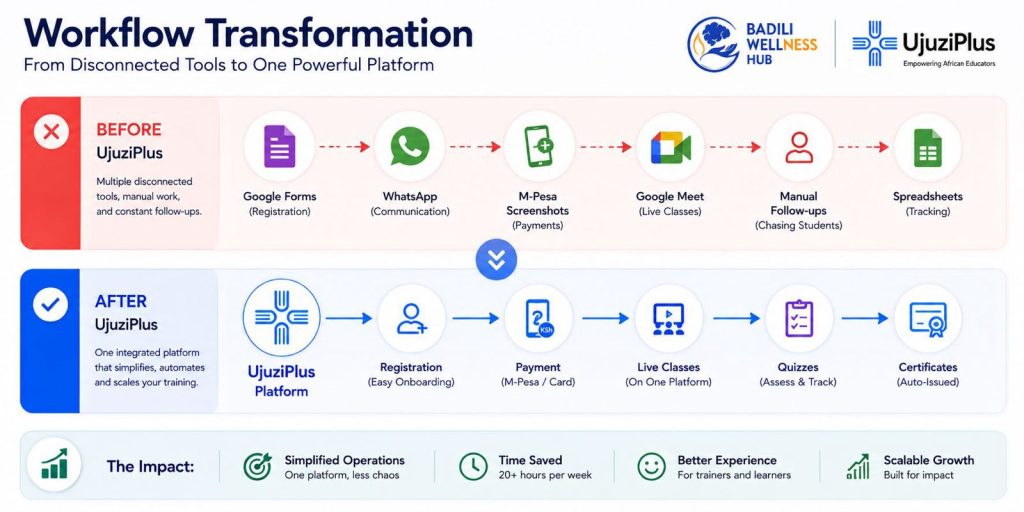
- Many trainers in Kenya still confirm payments manually by checking M-Pesa SMS messages and WhatsApp screenshots.
- Learners often wait hours or days for access because trainers must reconcile payments manually.
- HR teams struggle to track training budgets when payments are scattered across personal accounts.
- Mobile-first learners expect instant access after payment, not manual delays.
Step-by-Step: How Mobile Money LMS Systems Work
- Payment Initiation Learner pays via M-Pesa Paybill, Till Number, or STK push.
- API Integration LMS connects to mobile money APIs to confirm payment automatically.
- Enrollment Automation Once payment is confirmed, learner gains instant access to the course.
- Notifications Learner receives WhatsApp or SMS confirmation.
- Analytics & Reporting Trainers and HR teams track payments and enrollments via dashboards.
Market-Specific Insights
- Kenya: M-Pesa dominates; Paybill numbers are widely used for training payments.
- Nigeria: Mobile money adoption is growing, but bank transfers remain common.
- South Africa: Card payments are more common, but mobile-first solutions are emerging.
- Emerging markets: Mobile-first learners expect instant payment-to-access workflows.
Trends in Mobile Money LMS Systems
- API-driven automation reducing manual confirmations
- WhatsApp payment notifications integrated into LMS workflows
- AI-powered reconciliation for large-scale institutions
- Hybrid payment models combining mobile money with card options
- Micro-payments and subscriptions enabling learners to pay in installments
Common Mistakes
- Relying on manual payment confirmations via WhatsApp screenshots
- Using LMS platforms that do not support mobile money integration
- Ignoring low-bandwidth realities by requiring heavy desktop interfaces
- Failing to provide instant enrollment after payment
- Neglecting analytics for financial reporting
Comparison Table: Global LMS vs Mobile Money LMS
| Feature | Global LMS (Moodle, Kajabi) | Mobile Money LMS (Africa) |
|---|---|---|
| Payment methods | Stripe, PayPal | M-Pesa, Airtel Money |
| Enrollment confirmation | Manual or card-based | Automated via API |
| Communication | Email, Slack | WhatsApp, SMS |
| Learner access | Desktop + mobile | Mobile-first (Android) |
| Trainer workflows | Automated globally | Localized for mobile money |