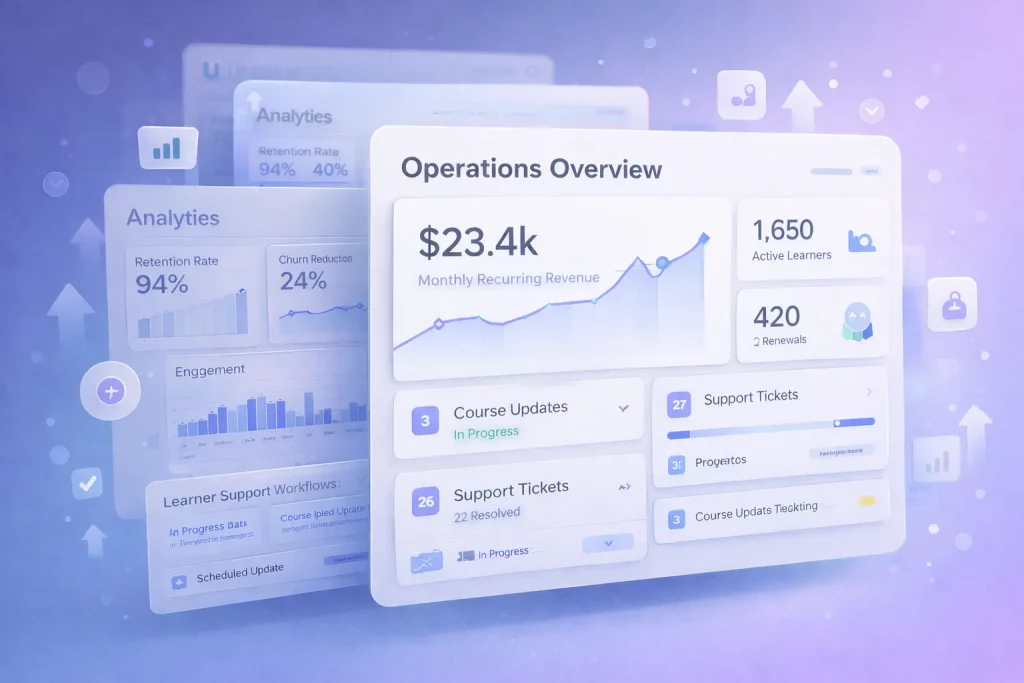
Global organizations stopped buying training tools and started operating capability systems. The learning management system for business now sits in the same execution layer as workforce planning, compliance governance, and performance rhythm. Most multi-country organizations still run learning as a collection of local programs. That structure no longer survives regulatory velocity, talent mobility, and board-level […]

Learning Management System for Business Compliance and Training
The compliance landscape no longer changes annually. It changes continuously, across jurisdictions, functions, and third-party ecosystems. A learning management system for business now sits inside governance, not inside “training.” Most executive teams still treat learning as a support activity. Regulators, customers, and boards now treat learning evidence as an operating control. Compliance has become an […]
How AI Is Transforming Corporate Learning Management Systems
AI has shifted the learning function from course distribution to performance control. The modern learning management system for business no longer succeeds by hosting content. It succeeds by directing capability, compliance, and productivity with the same rigor leaders expect from finance or operations. Most corporate learning management systems still operate as libraries. That model now […]
LMS Systems for Business Growth and Workforce Development
The learning stack stopped being a support function and became an operating system for execution. Corporate capability now changes at the same speed as products, policy, risk exposure, and customer expectations. An LMS is no longer a back-office repository; it is how the organization standardizes decisions and scales performance. Most organizations still run learning as […]
Corporate Learning Management Systems vs Traditional Training Methods
Corporate learning no longer competes on content quality. It competes on execution reliability across distributed teams, constant change, and measurable accountability. Traditional training methods were built for stable roles, predictable onboarding, and slow policy cycles. That operating environment no longer exists. Most organizations still fund training like it is an event, not an operating system […]
How to Choose a Learning Management System for Business
The LMS market stopped being a software category and became an operating decision. A learning management system for business now determines how fast strategy turns into capability, and how reliably compliance turns into evidence. Most organizations still buy it like a tool. They evaluate interfaces, course catalogs, and cost per user, then wonder why adoption […]
Best LMS for Organizations with Large and Distributed Teams
The learning landscape changed from “delivering courses” to “running a distributed operating system for capability.” Most leadership teams still select a platform as if training is a support function. It now behaves like infrastructure. Large and distributed teams raise the cost of inconsistency. The distance between strategy and execution widens when learning, compliance, and internal […]
Best LMS for Corporate Training in 2026
The LMS market stopped being a software category and became an operating model decision. In 2026, the best LMS for corporate training is the one that reduces execution variance across teams, locations, and roles while improving governance, data integrity, and speed of capability rollout. Most organizations still buy as if learning is a content problem. […]
LMS for Corporate Training: How Companies Upskill Employees at Scale
The LMS market has shifted from content distribution to operational control Corporate training no longer competes on course availability. It competes on whether capability can be governed like any other operational asset. The structural change is that skills now move with product cycles, regulatory exposure, tooling shifts, and customer expectations. The learning surface area expanded, […]
Corporate Learning Management Systems: What Modern Organizations Need in 2026
The landscape has structurally shifted from course delivery to operational governance Corporate learning is no longer a content problem. It is a governance problem with direct impact on audit exposure, capability readiness, and execution reliability. The structural change is this: learning now sits inside the operating system of the company. Corporate learning management systems are […]