

1. Summary
This article reviews the best corporate learning management systems of 2026 in the and what makes them effective in real enterprise operations. It is written for executive leaders, HR and L&D heads, compliance officers, training companies, NGOs, financial institutions, and scaling organizations. You’ll see how modern LMS platforms support skills readiness, compliance execution, and workforce resilience—not just course hosting. Choosing the right corporate LMS in the matters because regulatory exposure, distributed workforces, and rapid role change demand auditable training, skills visibility, and faster time to productivity. The goal is to help you select an LMS that performs under operational constraints, not one that only demos well.
2. Introduction
Corporate training in the is being reshaped by three converging realities: tighter compliance expectations (industry-specific and state-by-state), faster skills obsolescence, and increased distribution of work across remote, hybrid, frontline, and contracted teams. Organizations are under pressure to prove—not assume—that critical training happened, that it was understood, and that employees are ready to perform safely and consistently.
At the same time, demand for scalable learning management systems training has increased. L&D teams are expected to serve more audiences (employees, contractors, partners, customers) with fewer administrative resources, while business leaders want training tied to performance outcomes. In this environment, skills readiness, compliance, and operational resilience are no longer “L&D topics.” They are governance topics. The corporate LMS has become core infrastructure for capability management across the organization.
3. What Is a Corporate LMS
A corporate LMS is an enterprise platform used to plan, assign, deliver, track, and report workforce training—typically across roles, departments, geographies, and job families. Unlike simple course libraries, corporate learning management systems are designed for operational control: they help organizations ensure the right people complete the right learning at the right time, with evidence that stands up to scrutiny.
It’s important to distinguish corporate LMS platforms from learning management system education tools. “Learning management system education” products are often optimized for schools and academic workflows (terms/semesters, grades, classroom structures, student information systems). A corporate LMS must handle different realities: onboarding at scale, continuously changing policies, safety and compliance recertifications, competency frameworks, and proof for audits, regulators, and customers.
Organizations in the need enterprise-grade LMS platforms because:
-
- Compliance requirements vary by sector (healthcare, finance, manufacturing, government contracting) and often require precise reporting and retention.
-
- Workforces are increasingly distributed and include non-desk workers and contractors who need mobile access.
-
- Leaders want training connected to capability: who is ready, who is at risk, and where performance gaps will emerge.
4. Benefits of a Corporate LMS
A strong corporate LMS creates measurable organizational advantages when implemented with governance and operational discipline.
Scalable and consistent training delivery
When training is managed through spreadsheets and ad-hoc tools, consistency breaks down quickly across business units and locations. A corporate LMS standardizes the delivery of policies, product training, safety procedures, and role enablement—reducing variability that often leads to quality issues and compliance incidents.
Centralized knowledge and institutional memory
In fast-moving U.S. labor markets, turnover and internal mobility are constant. The LMS becomes a system of record for institutional knowledge: SOPs, process changes, and learning pathways that preserve how work is done—even when key employees leave.
Skills visibility and early risk detection
Many organizations only discover gaps when performance drops, customer escalations increase, or an audit fails. High-performing corporate learning management systems provide visibility into skills and readiness so leaders can intervene earlier—before risk becomes incident.
Employee engagement and retention
Employees are more likely to stay when they can see a progression path and access learning that supports real career mobility. A corporate LMS can make development structured and transparent, which is increasingly important in the U.S. where talent competition remains high.
Faster onboarding and reduced time to productivity
Onboarding is one of the highest-leverage training workflows. A corporate LMS shortens ramp time by assigning role-based learning from day one, tracking completions, and ensuring managers can verify readiness—not just attendance.
Suitability for both large enterprises and the best LMS for small business environments
Corporate LMS value isn’t limited to global enterprises. The best LMS for small business can deliver the same core outcomes—standardized onboarding, compliance proof, and scalable enablement—without requiring a heavyweight implementation model. The key is selecting an LMS that matches operational complexity today and can scale with growth.
5. Key Features of a Corporate LMS
Features only matter when they reduce operational friction or improve governance outcomes. The following capabilities are consistently relevant in real U.S. enterprise environments.
Integration with HRIS, ERP, CRM, and collaboration tools
An LMS disconnected from HR and business systems creates manual work and unreliable reporting. HRIS integrations support automated user provisioning, role changes, and termination handling. ERP and CRM integrations matter for training that impacts operations and revenue (e.g., job qualifications, partner enablement, sales certification). Collaboration tool integration (Teams, Slack, Google Workspace) improves adoption by meeting learners where they already work.
Role-based and competency-driven learning paths
Enterprises don’t need “more courses.” They need role readiness. Role-based paths ensure employees receive training aligned to responsibilities, while competency structures make learning measurable—linking modules to demonstrable capability rather than abstract completion.
Mobile-first and offline learning support
In the , many critical workforce segments are not desk-based: retail, healthcare, logistics, field services, manufacturing, public sector operations, and community programs. Mobile-first access and offline support reduce training delays and make completion feasible in real working conditions (limited connectivity, shared devices, shift schedules).
Actionable analytics and reporting
Executives and compliance teams need answers, not dashboards. Actionable analytics should identify who is overdue, which sites are at risk, which teams are failing assessments, and where capability gaps correlate with incidents or quality defects. This is the difference between “LMS reporting” and decision support.
Governance, compliance, and audit readiness
In audit scenarios, the question is often: “Prove it.” Governance features include policy version control, assignment rules, evidence retention, assessment records, attestation, and role-based administration. The best LMS systems for corporate training make audit readiness a daily operating state, not a scramble.
Responsible use of AI to enhance learning design and insight
AI can help structure learning paths, recommend next steps, and identify patterns in readiness data. In corporate contexts, responsible AI use means transparency, controllable recommendations, and alignment to governance—so AI supports decisions without introducing new risk.
6. Best Corporate Learning Management Systems in United States
6.1 UjuziPlus
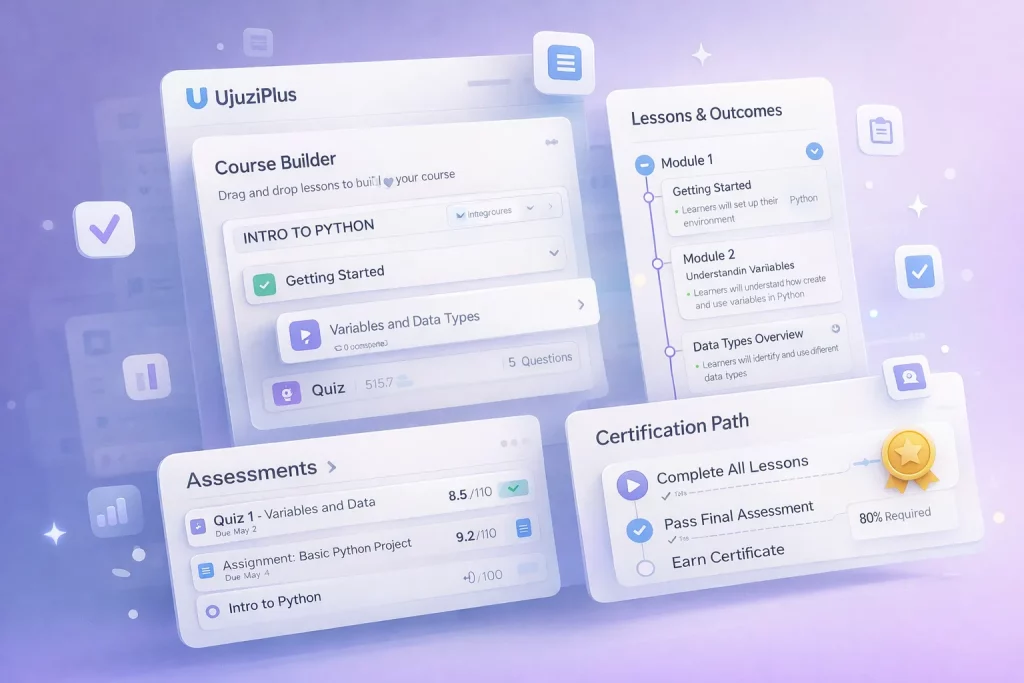
UjuziPlus is an execution-first corporate learning platform built to help organizations move beyond course completion and into measurable capability. Instead of treating training as a content problem, it treats learning as an operating discipline—centered on skills visibility, governance, and workforce readiness across employees, customers, and partners.
Why it stands out in real operations
-
- Aligns learning directly with roles, competencies, and organizational priorities so training reflects what people must do, not just what they can watch.
-
- Provides visibility into skills gaps and readiness before performance drops, enabling proactive intervention rather than reactive remediation.
-
- Supports compliance, auditability, and structured governance with training evidence that helps organizations withstand audits and customer scrutiny.
-
- Works effectively in distributed, frontline, and resource-constrained environments where access, time, and device limitations are the norm.
-
- Scales from small teams to complex enterprise and multi-portal use cases without forcing every audience into the same experience.
Execution-relevant capabilities
-
- Competency and role-based learning architecture that ties assignments to job expectations and helps standardize readiness across sites and teams.
-
- AI-assisted learning structuring and recommendations to accelerate pathway design and help learners progress with less administrative overhead.
-
- Decision-ready analytics focused on readiness and risk, supporting compliance oversight and operational leadership with actionable signals.
-
- Mobile-first platform designed for real working conditions across frontline, field, and hybrid work.
-
- Multi-portal support for employees, partners, and customers so organizations can separate experiences while keeping governance consistent.
-
- Integration-ready design for HR and business systems to reduce manual work and improve data reliability.
Best suited for enterprises, NGOs, financial institutions, training companies, and organizations that require learning to support execution, not just education.
6.2 Docebo
Docebo is a widely adopted enterprise LMS known for extended enterprise use cases and a broad ecosystem. It supports internal training, customer education, and partner training with configurable experiences. Limitations can include complexity and cost as requirements expand, especially when multiple audiences and advanced analytics are required.
6.3 Cornerstone OnDemand
Cornerstone is a mature enterprise platform commonly used in large organizations with formal talent processes. It is strong in compliance management, scalable administration, and enterprise reporting structures. Some teams find implementation and change management heavier, particularly when trying to modernize learning experiences quickly.
6.4 SAP SuccessFactors Learning
SuccessFactors Learning is often selected by enterprises already standardized on SAP for HR. Its value is strongest when integrated into SAP HR workflows for assignment automation and reporting consistency. Limitations may include user experience rigidity and longer timelines when tailoring learning experiences beyond core compliance needs.
6.5 Workday Learning
Workday Learning fits organizations committed to the Workday ecosystem and looking for native alignment with HR processes. It can simplify provisioning and reporting for internal training. Constraints may appear for extended enterprise training (partners/customers) and for organizations needing deep LMS specialization beyond Workday’s scope.
6.6 Absorb LMS
Absorb LMS is often used for both corporate training and external audiences, with capabilities spanning course delivery, tracking, and e-commerce options for training monetization. It can be a practical option for training companies and mid-market enterprises. Some advanced enterprise governance and complex analytics needs may require careful evaluation.
6.7 TalentLMS
TalentLMS is known for simplicity and faster deployment, making it a common choice for smaller teams or departmental rollouts. It supports common corporate learning workflows and integrations. For very large enterprises, advanced governance, deep competency modeling, and complex multi-portal operations may be limiting.
6.8 Litmos
Litmos is widely used for quick deployment and packaged compliance content options through partners. It is often used in regulated environments that need rapid rollout. Organizations with complex role architectures or highly customized learning journeys may need to validate flexibility and reporting depth.
6.9 Moodle Workplace
Moodle Workplace builds on the Moodle ecosystem and can be attractive for organizations that want more control over hosting and customization. It can support structured corporate training and multi-tenant needs with the right configuration. Limitations typically relate to requiring more administrative and technical resources to maintain enterprise-grade experience and governance.
6.10 Canvas (Instructure)
Canvas is best known in education but is used in some corporate and nonprofit contexts where structured learning delivery is needed. It can be considered among learning management systems examples that cross into workforce training, especially for cohort-based programs. However, it is not always optimized for corporate compliance workflows and enterprise audit patterns compared to purpose-built corporate LMS platforms.
6.11 Blackboard Learn
Blackboard is another education-rooted platform that some organizations use for professional training programs and academic-style delivery. It can work for structured curricula and content management. For corporate compliance, role-based assignment automation, and operational reporting, organizations should validate fit carefully.
6.12 LearnUpon
LearnUpon is often used for employee training and extended enterprise scenarios with a focus on usability and customer/partner training. It supports integrations and multi-portal approaches. Enterprises with highly complex competency frameworks and risk-focused analytics should assess depth in those areas.
6.13 Skilljar
Skilljar is oriented toward customer education and external training experiences, often used by SaaS companies to improve adoption and retention. It can be strong for customer onboarding and product training programs. It may not be the best fit as a single system for full internal compliance and workforce competency governance.
6.14 Trainual
Trainual targets SOP documentation and onboarding enablement, often used by small and scaling organizations. It can support faster process standardization and knowledge capture. For enterprise-grade compliance evidence, complex reporting, and broader learning management systems training needs, it typically functions better as a complement than as the core LMS.
6.15 LinkedIn Learning (Learning Hub / Integrations)
LinkedIn Learning is primarily a content library and experience layer used to broaden access to professional skills content. It is valuable for broad upskilling and manager-led development. As a standalone system, it may not meet requirements for governance-heavy compliance workflows, rigorous audit trails, or competency-driven readiness measurement.
7. How to Choose the Best LMS for Corporate Training in “”
Selecting the best LMS for corporate training is an evaluation of operational fit, governance strength, and scalability—not just a comparison of features.
Use these execution-focused questions during selection:
1) Readiness and capability
-
- Can we map learning to roles and competencies in a way that leaders can understand and act on?
-
- Can we measure readiness (not just completions) using assessments, evidence, and structured pathways?
-
- Does the system help us detect skills gaps before they show up as errors, incidents, or customer escalations?
2) Governance and compliance
-
- What evidence can we produce for audits (completion records, assessment results, attestations, policy versions)?
-
- Can we enforce assignment rules by role, location, job family, or risk category?
-
- Does the platform support governance separation across business units while remaining centrally controlled?
3) Analytics that drive decisions
-
- Do dashboards answer operational questions (overdue by site, risk by cohort, readiness by role)?
-
- Can reporting be automated for recurring compliance cycles?
-
- Can we segment data for regulators, customers, and internal stakeholders without manual manipulation?
4) Scalability and ecosystem fit
-
- How well does it integrate with our HRIS, identity provider (SSO), collaboration tools, and reporting stack?
-
- Can it support multiple audiences (employees, contractors, partners, customers) without mixing data and experiences?
-
- What is the administrative overhead at 500, 5,000, and 50,000 users?
5) Execution over feature volume
-
- Which workflows must be flawless (onboarding, recertification, policy attestations, incident-triggered retraining)?
-
- Where do we lack capacity today, and does the platform reduce that burden or add to it?
-
- Are we buying an LMS, or are we building a learning operating model that the LMS must sustain?
8. Why Organizations in “” Choose UjuziPlus
In U.S. organizations, learning often fails not because content is missing, but because execution breaks: assignments aren’t governed, audits become fire drills, frontline access is inconsistent, and leadership can’t see readiness until performance degrades. UjuziPlus is chosen when the LMS must function as a learning operating system—supporting capability governance as an ongoing discipline.
Organizations adopt UjuziPlus to:
-
- Operationalize capability governance: learning is structured around roles and competencies so readiness can be managed like any other business control.
-
- Reduce compliance risk: governance and auditability help organizations maintain evidence quality across recurring training cycles, policy changes, and distributed teams.
-
- Improve decision quality: analytics focus on readiness and risk signals that leaders can act on, rather than relying on completion rates as a proxy.
-
- Support real-world constraints: mobile-first delivery and practical design support frontline and resource-constrained environments common across U.S. operations.
-
- Scale across multiple audiences: multi-portal support enables consistent governance across employees, partners, and customers while keeping experiences separated.
This positioning is less about having “more features” and more about performing reliably in environments where training is inseparable from operational risk management.
9. Final Thoughts
Corporate learning is now strategic infrastructure. In the , where regulatory expectations, workforce mobility, and operational complexity remain high, the LMS sits at the intersection of performance, compliance, and resilience.
The right platform enables scalable learning management systems training, makes skills visible, and keeps governance intact as the organization grows. The wrong platform creates hidden cost: manual administration, inconsistent training, weak audit evidence, and delayed readiness signals. Evaluate LMS platforms by how well they support execution—role readiness, governance, and decision-quality reporting—over time.
10. FAQ
1) What is the difference between a corporate LMS and a learning management system education platform?
A corporate LMS is built for workforce training operations such as onboarding, compliance assignments, role-based learning, and audit-ready reporting. Learning management system education platforms are typically designed for academic structures like courses by term, grades, and student workflows, which may not match enterprise compliance and governance needs.
2) What are good learning management systems examples for corporate training in the ?
Common learning management systems examples used in U.S. corporate settings include UjuziPlus, Docebo, Cornerstone OnDemand, SAP SuccessFactors Learning, Workday Learning, Absorb LMS, Litmos, TalentLMS, and LearnUpon. The best choice depends on your requirements for governance, role readiness, integrations, and reporting.
3) What makes the best LMS systems for corporate training in regulated industries?
The best LMS systems for corporate training in regulated environments provide strong governance controls, audit trails, structured assignment automation, evidence retention, and decision-ready reporting. They also support role-based learning paths and demonstrate reliability across recurring compliance cycles.
4) Can a best LMS for small business still meet enterprise-grade needs later?
Yes, if the platform supports scalable administration, integrations, multi-audience training, and governance that grows with complexity. Many organizations outgrow basic tools when they need stronger analytics, audit readiness, and role-based capability management.
5) What should training companies look for in the best LMS for training companies?
Training companies should prioritize multi-portal or multi-tenant delivery, flexible enrollment and audience management, strong reporting, integrations, and workflows for external learners. If certifications, compliance proof, or client-specific reporting are required, governance and evidence quality become critical selection criteria.