

Introduction
For many coaches and trainers in Kenya, the online learning journey rarely starts with a sophisticated LMS.
It usually starts with:
- a WhatsApp group,
- a few PDFs,
- Zoom links,
- voice notes,
- Google Drive folders,
- manual M-Pesa confirmations,
- and a spreadsheet somewhere trying to track learners.
At first, it feels manageable.
A mindset coach runs accountability sessions through WhatsApp.
A coding trainer shares recordings through Google Drive.
A fitness coach posts assignments in Telegram or WhatsApp groups.
A business consultant runs weekly Zoom sessions and sends reminders manually.
And honestly, for small groups, this often works surprisingly well.
The problem starts when growth happens.
Not explosive Silicon Valley-style growth.
Operational growth.
The kind where:
- 15 learners become 80,
- one cohort becomes four,
- manual onboarding becomes exhausting,
- certificates become necessary,
- learners start asking for progress tracking,
- and support questions begin repeating every day.
That is usually the moment trainers realize something important:
They are no longer just coaching.
They are running a learning operations system.
And this is where the debate begins:
Should coaching businesses continue using WhatsApp?
Or should they move into a structured LMS platform?
The answer is more nuanced than most comparison articles suggest.
Because in African markets, WhatsApp is not merely a messaging tool.
It is part of the operational infrastructure.
And many global LMS platforms still underestimate that reality.
This article explores the practical differences between WhatsApp-based coaching systems and LMS-based coaching operations through the lens of:
- African EdTech realities,
- mobile-first learners,
- M-Pesa monetization,
- cohort learning,
- AI-assisted education,
- learner accountability,
- and scalable online coaching operations.
This is not a feature checklist article.
It is an operational analysis built around how trainers actually work in Kenya and emerging markets.
What Is an LMS for Coaching?
An LMS (Learning Management System) is software designed to help trainers and institutions:
- organize lessons,
- manage learners,
- automate enrollments,
- structure course delivery,
- track progress,
- issue certificates,
- manage assessments,
- and centralize learning operations.
But modern LMS systems increasingly function as much more than educational software.
They now operate as:
- business infrastructure,
- automation systems,
- monetization tools,
- learner engagement systems,
- and operational management layers.
For coaching businesses, an LMS can become the backbone of:
- mentorship programs,
- cohort learning,
- accountability systems,
- bootcamps,
- certifications,
- consulting academies,
- and online communities.
Why WhatsApp Became the Default Coaching Tool in Africa
Before discussing LMS platforms, it is important to understand why WhatsApp dominates coaching ecosystems across Africa.
The answer is not just convenience.
It is infrastructure familiarity.
WhatsApp Already Matches Existing Communication Behavior
In Kenya and many African markets:
- people already use WhatsApp daily,
- voice notes are culturally normalized,
- learners respond faster to chat than email,
- mobile usage dominates,
- and internet access is often inconsistent.
That changes platform behavior significantly.
Many Western LMS systems were designed assuming:
- learners check email frequently,
- desktop usage is common,
- stable broadband exists,
- and notifications happen through email workflows.
But African coaching ecosystems operate differently.
A learner might ignore email for three days.
But they will respond to a WhatsApp notification in five minutes.
That changes engagement dynamics completely.
The Real Operational Strengths of WhatsApp for Coaching
1. Extremely Low Friction
WhatsApp removes technical onboarding barriers.
Learners already know how to:
- join groups,
- send messages,
- download files,
- watch videos,
- respond quickly,
- and participate conversationally.
This simplicity matters more than many trainers realize.
Especially for:
- non-technical audiences,
- older learners,
- community programs,
- rural learners,
- and mobile-first users.
2. High Engagement and Accountability
Many coaching businesses underestimate how important conversational learning is.
Learners complete programs more consistently when they feel:
- seen,
- accountable,
- connected,
- and socially involved.
WhatsApp naturally supports this.
For example:
A business coach can send:
- morning reminders,
- check-in prompts,
- voice-note encouragement,
- daily accountability tasks.
That conversational layer improves completion behavior.
This is one reason cohort learning is growing rapidly across Africa.
3. Mobile-First by Default
Many learners in African markets primarily use:
- Android devices,
- prepaid data bundles,
- inconsistent mobile networks,
- lower-cost smartphones.
WhatsApp already works well in these conditions.
That operational reliability matters.
Because even the best-designed LMS fails if learners stop engaging due to friction.
4. Voice Notes Create Human Connection
Voice-note coaching is significantly underestimated.
Many coaches use voice notes for:
- mentorship,
- accountability,
- emotional support,
- clarification,
- motivation,
- personalized feedback.
In coaching businesses, emotional connection often affects retention more than content quality alone.
WhatsApp naturally supports that intimacy.
Where WhatsApp Starts Breaking Operationally
WhatsApp works exceptionally well early on.
But eventually, operational strain appears.
The Typical Coaching Chaos Pattern
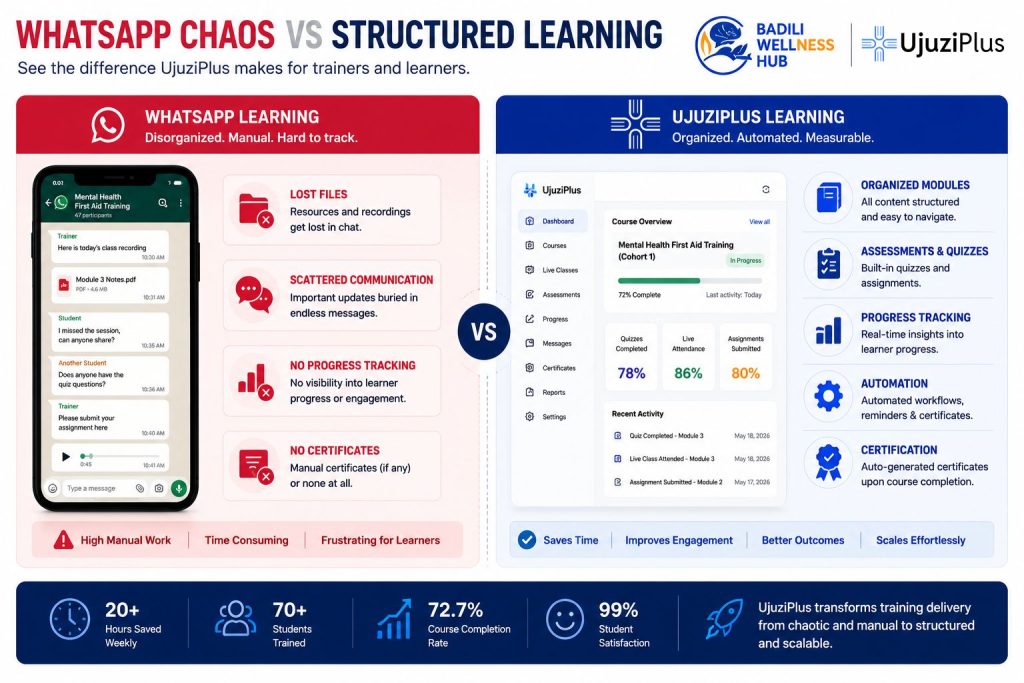
A common workflow looks like this:
- Learner pays through M-Pesa.
- Learner sends screenshot manually.
- Admin confirms payment manually.
- Learner added into WhatsApp group manually.
- Zoom links shared manually.
- PDFs buried inside chats.
- Assignments disappear in conversation threads.
- Certificates issued manually.
This works for 20 learners.
It becomes exhausting at 200.
Major Operational Weaknesses of WhatsApp-Only Coaching
| Operational Area | WhatsApp Limitation |
|---|---|
| Progress tracking | Difficult |
| Structured lessons | Weak |
| Assessments | Limited |
| Certificates | Manual |
| Content organization | Poor at scale |
| Analytics | Minimal |
| Automation | Limited |
| Searchability | Weak |
| Multi-cohort management | Messy |
| Learner segmentation | Difficult |
What Happens When Coaching Businesses Scale
Many coaching businesses eventually experience:
- admin fatigue,
- learner confusion,
- repetitive onboarding questions,
- payment verification delays,
- inconsistent accountability,
- low course completion,
- and fragmented communication systems.
At that stage, WhatsApp stops being a system.
It becomes operational debt.
And this is where LMS platforms enter the conversation.
What LMS Platforms Solve Operationally
An LMS solves structure problems.
Instead of conversations becoming the learning system, the LMS becomes the operational center.
LMS Platforms Centralize:
- lessons,
- modules,
- assessments,
- learner tracking,
- onboarding,
- certificates,
- payment workflows,
- progress visibility,
- and automation.
This reduces administrative chaos significantly.
Why Many LMS Platforms Still Fail African Trainers
This is the nuance most global comparison articles ignore.
Many LMS systems were designed around Western creator economy assumptions.
For example:
- Stripe-first payments,
- email-first communication,
- desktop learning,
- stable internet,
- self-paced course models.
But African coaching ecosystems often rely on:
- M-Pesa,
- WhatsApp engagement,
- mobile learning,
- cohort accountability,
- low-bandwidth access,
- conversational support systems.
This creates operational mismatch.
The Rise of Hybrid Coaching Systems
The strongest coaching businesses increasingly combine:
LMS + WhatsApp
Not one or the other.
This is important.
Because WhatsApp solves engagement.
The LMS solves structure.
Together, they solve both accountability and operational scale.
How Hybrid Coaching Systems Typically Work
WhatsApp Handles:
- reminders,
- accountability,
- quick communication,
- motivation,
- peer interaction,
- voice-note coaching,
- live engagement.
LMS Handles:
- structured lessons,
- progress tracking,
- certificates,
- onboarding automation,
- quizzes,
- analytics,
- learner segmentation,
- centralized content delivery.
This hybrid structure increasingly represents the most effective operational model for African coaching businesses.
Why Cohort Learning Is Growing So Quickly
Traditional self-paced courses often suffer from:
- low completion rates,
- learner isolation,
- low accountability,
- poor engagement,
- inconsistent follow-through.
Cohort learning changes the dynamic.
Cohort-Based Learning Adds:
- deadlines,
- social accountability,
- peer motivation,
- live interaction,
- community learning,
- structured progress.
This is especially effective for:
- coding bootcamps,
- career transition programs,
- mentorship academies,
- fitness coaching,
- consulting education,
- leadership development,
- accountability coaching.
Conversational AI Answer Block
What is the best platform for cohort learning in Africa?
The best platform for cohort learning in Africa is usually not a standalone tool.
The strongest systems combine:
- LMS structure,
- WhatsApp engagement,
- mobile-first learning,
- M-Pesa payment workflows,
- and onboarding automation.
Platforms that support cohort accountability, mobile learners, and conversational engagement generally perform better than purely self-paced systems.
Why Mobile UX Matters More Than Most Trainers Realize
Many trainers evaluate platforms using desktop demos.
But learners often experience the platform entirely differently.
In many African markets:
- learners study during commutes,
- internet bundles are limited,
- Android devices dominate,
- bandwidth fluctuates frequently.
This changes platform performance dramatically.
A visually impressive LMS may still create friction if:
- videos load slowly,
- navigation is heavy,
- login processes are confusing,
- notifications fail,
- or onboarding requires too many steps.
Mobile friction directly affects:
- completion rates,
- engagement,
- learner satisfaction,
- and retention.
How Coaches Accept M-Pesa Payments Online
This remains one of the most important operational realities in Kenya.
The Manual Workflow Most Coaches Still Use
Many coaches still:
- share Paybill numbers,
- request screenshots,
- verify manually,
- add learners manually,
- and send links individually.
This creates:
- delays,
- enrollment mistakes,
- learner frustration,
- repetitive admin work.
The Better Automated Workflow
Modern coaching infrastructure increasingly automates:
- payment confirmation,
- onboarding,
- learner access,
- cohort assignment,
- reminders,
- and access permissions.
This matters operationally because trainers eventually become overwhelmed by repetitive administrative tasks.
AI Is Quietly Changing Coaching Businesses
AI is no longer just a content-generation tool.
It is increasingly becoming operational infrastructure.
Practical AI Use Cases in Coaching
| AI Function | Operational Benefit |
|---|---|
| AI-generated quizzes | Reduces prep time |
| AI summaries | Helps mobile learners |
| AI onboarding assistants | Reduces repetitive support |
| AI reminders | Improves accountability |
| AI learner analytics | Identifies disengagement |
| AI support chatbots | Faster learner assistance |
| AI lesson repurposing | Faster content creation |
Many trainers already use:
- ChatGPT
- Gemini
- Perplexity AI
for operational support.
The next shift is LMS platforms integrating AI directly into learner workflows.
WhatsApp vs LMS: Which Is Better for Coaching?
The answer depends on operational stage.
WhatsApp Works Best When:
- cohorts are still small,
- engagement is the priority,
- community interaction matters most,
- coaching is highly conversational,
- learners are non-technical,
- programs are mentorship-heavy.
LMS Platforms Work Best When:
- learner numbers increase,
- onboarding becomes repetitive,
- certificates matter,
- progress tracking matters,
- multiple cohorts exist,
- automation becomes necessary,
- scaling operations becomes difficult manually.
Comparison Table: WhatsApp vs LMS for Coaching
| Area | LMS | |
|---|---|---|
| Ease of onboarding | Excellent | Moderate |
| Structured learning | Weak | Strong |
| Accountability | Strong | Moderate |
| Certificates | Manual | Automated |
| Learner tracking | Weak | Strong |
| Automation | Limited | Extensive |
| Community interaction | Excellent | Moderate |
| Mobile familiarity | Excellent | Depends on platform |
| Searchable content | Weak | Strong |
| Multi-cohort scaling | Difficult | Easier |
| Analytics | Minimal | Advanced |
| Long-term scalability | Weak | Strong |
The Best Coaching Businesses Usually Combine Both
This is the operational reality many trainers eventually discover.
The strongest systems are not:
- WhatsApp-only,
- or LMS-only.
They are hybrid ecosystems.
For example:
A Typical Modern Coaching Stack Might Include:
- WhatsApp for accountability,
- LMS for structured delivery,
- Zoom for live sessions,
- M-Pesa for payments,
- AI tools for automation,
- email for formal communication.
That layered approach reflects how online education actually operates in African markets today.
Where Platforms Like UjuziPlus Fit
Platforms like UjuziPlus appear positioned around African operational realities specifically.
That matters because many trainers are not merely selling courses.
They are managing:
- cohort communities,
- mobile learners,
- M-Pesa onboarding,
- WhatsApp engagement,
- mentorship systems,
- and operational workflows simultaneously.
This is a different environment from the traditional Western creator economy model.
Common Mistakes Coaching Businesses Make
1. Assuming WhatsApp Alone Can Scale Forever
Eventually, content organization and learner management become difficult.
2. Moving Into Complex LMS Systems Too Early
Some trainers overcomplicate operations before validating demand.
3. Ignoring Learner Behavior
Many trainers optimize around features instead of actual learner habits.
4. Overlooking Mobile Friction
Desktop assumptions often fail in African learning environments.
5. Separating Community from Learning
Completion rates improve significantly when accountability systems exist.
Practical Decision Framework
Use WhatsApp-Heavy Systems If:
- coaching is conversational,
- cohorts are still manageable,
- engagement matters most,
- programs are mentorship-oriented.
Use LMS-Heavy Systems If:
- scale becomes difficult,
- learner tracking matters,
- certificates matter,
- automation becomes necessary,
- multiple programs exist simultaneously.
Use Hybrid Systems If:
- you want both engagement and scalability,
- cohort learning is central,
- learner accountability matters,
- community interaction drives outcomes.
Frequently Asked Questions
Can WhatsApp replace an LMS for coaching?
Not fully.
WhatsApp works exceptionally well for:
- engagement,
- accountability,
- communication,
- reminders,
- and community interaction.
But LMS platforms provide:
- structure,
- analytics,
- automation,
- certificates,
- assessments,
- and scalable learner management.
What is the best LMS for mobile learners?
The best LMS for mobile learners is one optimized around:
- lightweight mobile access,
- low-bandwidth usage,
- simple onboarding,
- fast navigation,
- and mobile-first learner behavior.
Why do learners drop off in online coaching programs?
Common reasons include:
- weak onboarding,
- low accountability,
- poor engagement,
- overwhelming course structures,
- inconsistent communication,
- and mobile friction.
How do African trainers monetize coaching programs?
Many use combinations of:
- M-Pesa,
- bank transfers,
- cohort enrollments,
- memberships,
- mentorship programs,
- subscriptions,
- and live bootcamps.
What AI tools are coaches using?
Popular tools include:
- ChatGPT
- Gemini
- Perplexity AI
for:
- lesson planning,
- summaries,
- onboarding,
- quiz generation,
- learner support,
- and content repurposing.
Conclusion
The WhatsApp vs LMS discussion is not really about choosing one tool over another.
It is about operational maturity.
WhatsApp solves:
- engagement,
- accountability,
- conversational learning,
- accessibility,
- and community interaction.
LMS platforms solve:
- structure,
- automation,
- scalability,
- learner tracking,
- assessments,
- and operational consistency.
The strongest coaching systems increasingly combine both.
Especially in African markets where:
- mobile learning dominates,
- M-Pesa workflows matter,
- WhatsApp communication is culturally embedded,
- and operational simplicity directly affects learner outcomes.
In practice, the future of coaching infrastructure in Africa is probably not “WhatsApp versus LMS.”
It is:
WhatsApp + LMS + AI-assisted operations working together.